I am sure you’ve heard about razors, you may have even tried them (and who am I to judge you for that?) However, the reason I wanted to mention them in this post is that there is a very specific pricing strategy that was adopted by King C. Gillette:
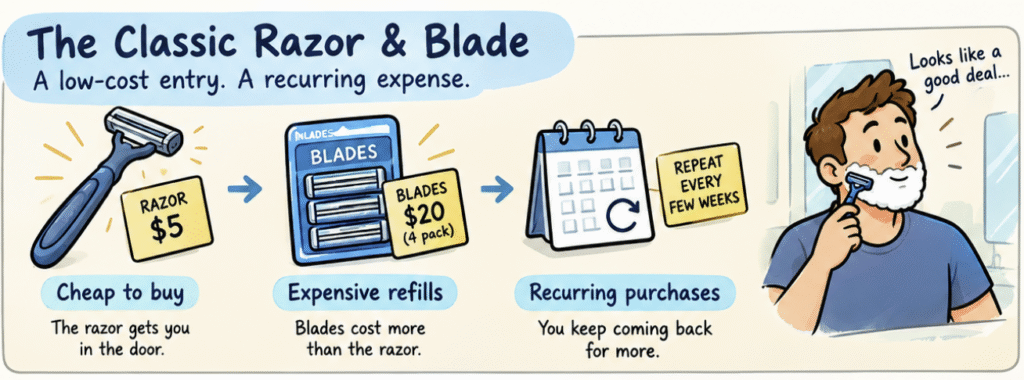
The strategy is still valid today, not surprisingly it’s called “razor and blades”, and, in a nutshell, it is all about hooking you up on something by selling it cheap, then making sure you pay more for the replaceable parts/addon-s to keep using that cheap initial item.
Still, that original Razor & Blade was simple and straightforward. The modern razor and blade which AI companies have adopted… that’s a way more elaborate strategy, but eventually, it all comes down to the same idea: you get the tool cheap or for free, and then you start adding more and more add-ons around it to get better features. And, among other caveats, there is a one in particular which basically says “the features are usually offered by the same company”.
So, for example, consider Microsoft Copilot scenarios:
- A developer, who typically has required licenses to use Power Platform, who may also have access to the required Azure subsriptions, and who is unlikely to use either of that at scale, can develop an application
- That developer can use Github Copilot, possibly Copilot Code, maybe Microsoft Copilot Studio… Neither of that is terribly expensive to use when starting to build something
- It is worth mentioning, though, that, as the application starts becoming more advanced, and so it starts to require more Copilot credits to add new features simply because of the “context” Copilot has to review before adding those features, the price start going up
- What definitly is worth mentioning, though, is how this scales to the other users. Is there a premium connector? That’s it, once another user decides to use that application, they basically need a license. Is that applicaiton using AI to summarize documetns, for example? That’s a nice feature, but now multiply it by all the users who are going to use it and don’t forget to sum up the costs.
Microsoft would, of course, describe it as a new and more exciting way of doing things, but, once you have lost the ability to do anything manually simple because you were not paying attention to what AI has been doing and what it has “developed” for you, you can either choose to pay for those extra credits to fix another bug, or… there is no “or”. Why would you lose that ability? Realistically, there is simply no way a human engineer can keep up with all the code AI can produce quickly.
Is it only Microsoft, though? Not at all.
Consider OpenAI. You start with a free tier, you start using it, you like image generation, then you somehow need a better model, and you want to create a site, and, sudenly you are looking at having to pay for:
- Access to the premium models
- Codex
- High-volume usage
- Additional Credits
And what’s the story with Anthropic? It’s pretty much the same – the basic tool is cheap, but you start building something real and it starts costing you a lot more.
Which is where the modern “AI Razor & Blade” strategy shows up:
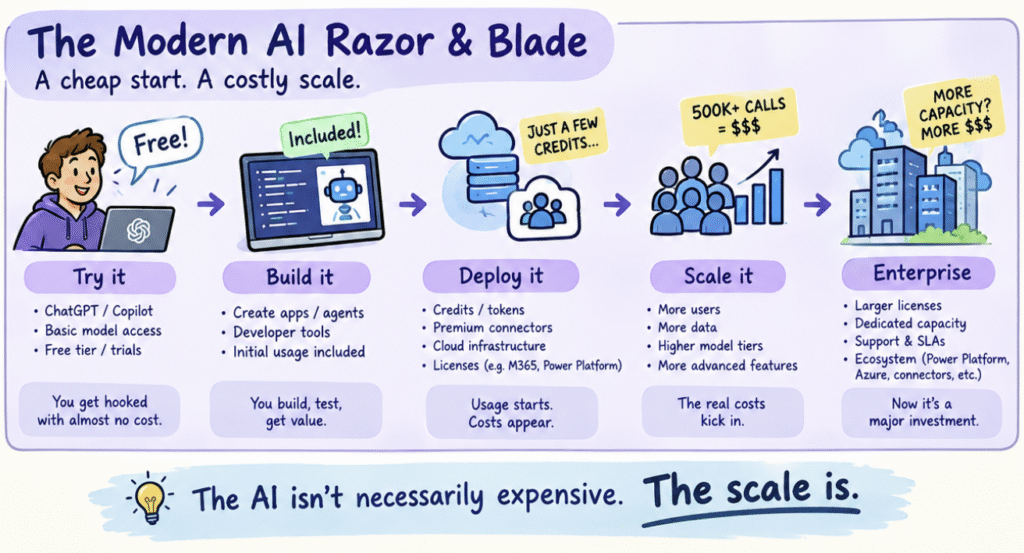
It is way more advanced and subtle – those companies are not just selling you the razor, they are helping you build the machine that will consume the blades. You do it for them while paying them for the joy of doing it, and, once it’s done, they are going to monetize the outcomes. Although, to be fair, that’s what the cloud has always been about, though now we have that extra layer where the vendors will actually sponsor your initial effort of getting hooked on the AI services.
It’s also not that AI comes with just one blade. It comes with a few.
First, there is intelligence. You will be paying for: premium models, higher reasoning, larger context, image/video generation, Codex/agents.
There is, also, consumption. This is where you will be paying for: tokens, credits, API calls, agent executions, compute.
Then there is the ecosystem, which includes: licenses, connectors, storage, Dataverse, Azure, security/compliance, infrastructure.
Historically, I used to work on the D365/Power Platform implementations, I would not be a Power Platform consultant if I did not talk about Microsoft a bit more. Even a year or two ago I was wondering if Microsoft’s “copilot everywhere” strategy was reckless. I still don’t know if it is going to work – a lot depends on what happens next with the AI in general, with the Microsoft’s implementation in particular, etc. What I do know is that Microsoft can sell you all 3 types of those blades, unlike the purebred AI companies.
You can generally pick and choose a model, including some of the Microsoft’s own models, and Microsoft will simply the costs to you, likely with some profit. The same goes for consumption. What Microsoft can do exceptionally well, at least when compared to Open AI or Anthropic, is to sell access to the “ecosystem”. Does a regular person need it that much? Probably no. Does an enterprise organization need access to the infrastructure that includes Entra ID, Purview, Dataverse, Power Platform, premium connectors, storage, etc? Absolutely, noone wants to try rebuilding all or even a part of that from scratch.
Neither Open AI nor Anthropic have the advantage of offering that kind of large underlying ecosystem, so they are mostly betting on offering cutting edge models to supply the best intelligence and conumption. Microsoft, instead, is betting more on integrating its ecosystem with any kind of intelligence and consumption while still offering intelligence and consumption, even if it’s often relying on external services for the latter.
However, they are all converging on the same approach, even if they are executing it differently. Cheap initial offering, which is often simply “sponsored”, make you want to use AI (and, sometime, you have little choice left but to use it). But the better you feel about using AI, and the better AI works, the more expensive it becomes in the long term because of everything that comes with it.
Sure you can say that services cost money, there is nothing surprising about Microsoft, OpenAI, and/or Anthropic asking you to pay. That’s fair, but that’s not really the point. When Microsoft is pushing Copilot everywhere, it is not to your advantage, definitely not only. It is also about making it so intertwined with what you and the other users normally do that at some point you just say “oh, I cannot do it without AI”, so your intelligence/consumption/ecosystem costs will become more or less non-negotiable.
But here is the thing: Microsoft can resell consumption and intelligence from anyone offering it, but AI providers are not very likely to offer the same sort of matching ecosystem any time soon.
Still, to the extent possible, they are all trying to do the same: the “AI version” of razor and blade strategy is not to monetize the “blades”, where you start cheap, and then you just keep buying the blades over and over. With the AI, you start cheap to get a taste, and, then, you gradually start increasing your spendings.
However, you know what it starts reminding? Basically, it’s a dependency loop. You taste it, you like it, you want more of it, and, once you get used to it, it becomes extremely difficult to somehow keep going without it. Hence, it’s not surprising at all that companies like Microsoft / Open AI / Anthropic will be doing what they can to actually make it easy to start using some form of AI. They have the hype, phsychology, and technology on their side. And, in general it’s not that bad, except that, of course, once you are in, there may be no way out.